GTFIS WhiteHorseBlade-SpaceSuit

Space does not only move by position. It moves by timing.
WhiteHorseBlade-SpaceSuit is the orbital intelligence branch of GTFIS, designed to study the hidden timing structure inside satellite constellations, debris fields, and near-Earth orbital systems.
Traditional space situational awareness often focuses on object-level tracking: where something is, where it is going, and whether two objects may pass too closely. SpaceSuit adds another layer. It looks at the system-wide behavior forming around those objects: repeated proximity patterns, compression states, orbital crowding, timing locks, quiet buildup, and nonlinear coupling across the field.
In simple terms:
SpaceSuit studies when the orbital environment begins behaving less like scattered objects and more like a coupled system.
That distinction matters.
A satellite may not appear dangerous by itself. A conjunction may not appear catastrophic by itself. But when repeated pairings, neighbor persistence, rising constraint, quiet compression, and hazard loading begin stacking together, the orbital field may be entering a more fragile timing state.
SpaceSuit is built to identify those fragile windows.
It does not replace existing orbital tracking systems. It adds a new interpretive layer above them: a temporal stability and cascade-risk lens for satellite operators, mission planners, space traffic managers, defense researchers, and future autonomous orbital decision systems.
Core Concepts---
Constraint measures how locked or restricted the orbital relationships are becoming.
Alignment measures coherence across the tracked system.
Quietness highlights deceptively calm periods where instability may be accumulating beneath the surface.
Degrees of Freedom estimate how much maneuvering or dispersion room remains in the field.
Hazard Load reflects pressure accumulating through close approaches, repeated interactions, or elevated system activity.
Together, these signals help SpaceSuit identify conditions such as:
Lock Surge — a sudden rise in orbital constraint.
Quiet Lock — a calm but compressed state.
Conjunction Compression — crowding around close-approach windows.
Persistent Neighbor Lock — repeated clustering among the same objects.
Rising Load — a growing hazard environment.
Cascade Candidate — a high-risk instability configuration requiring deeper review.
GTFIS WhiteHorseBlade-SpaceSuit | Kairos

Kairos Burns are timing-optimized orbital maneuvers identified by WhiteHorseBlade-SpaceSuit. Instead of maneuvering only at the moment of highest apparent collision risk, SpaceSuit searches for nonlinear decoupling windows where a small adjustment may disrupt future synchronization, reduce cascade potential, and preserve maneuver freedom. These windows often appear after a compression/release event, before the orbital field re-locks into stronger coupling.

Starlink (1k chunk) -- Sustained Interaction Shelf | July 6 - July 10, 2026 - *parameters*
>> --start 2026-07-06T05:00:00 `
>> --end 2026-07-10T23:59:00 `
>> --step 3 `
>> --conjunction-threshold-km 16 `
>> --repeated-pair-distance-km 75 `
>> --dof-probe-km 5 `
>> --neighbor-k 4 `
>> --neighbor-persistence-distance-km 120
>> --tle=oneweb_20260706_0856.tle
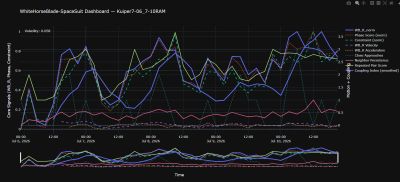
Kuiper (Full) Constellation Study | July 06 - July 10, 2026
>> --step 3 `
>> --conjunction-threshold-km 18 `
>> --repeated-pair-distance-km 90 `
>> --dof-probe-km 6 `
>> --neighbor-k 4 `
>> --neighbor-persistence-distance-km 150
>> --tle=oneweb_20260706_0856.tle
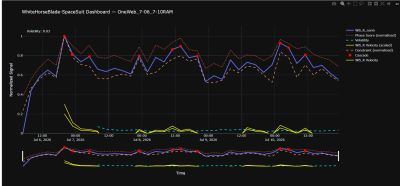
OneWeb (full) - Sharp Constraint / Lock Crest | July 06 - July 10, 2026
>> --step 3 `
>> --conjunction-threshold-km 18 `
>> --repeated-pair-distance-km 85 `
>> --dof-probe-km 6 `
>> --neighbor-k 4 `
>> --neighbor-persistence-distance-km 140 `
>> --tle=oneweb_20260706_0856.tle